

Designing for different ways to get paid
Creating distinct workflows for payment links and invoices while keeping the broader financial experience cohesive.
ROLE
Product Designer
TIMELINE
Jan 2026—Present
TEAM
1 PM, 2 Engineers
STATUS
Shipped
IMPACT
98% task completion rate (13 tested)
Overview
In early 2026, Tribe Money pivoted concepts into the fintech SaaS and AI space, providing early-stage founders, freelancers, and SMBs with frictionless access to unified financing tools without the need to incorporate.
Understanding the pain points of these users, I identified areas of friction in the financial admin, and determined that the goal is to lower cognitive load and remove unnecessary steps to task completion.
Role and Responsibilities
I led the 0-1 design of the payment links and invoicing workflows, translating ambiguous business needs into a unified payment system for collecting and distributing money. Through meetings with founders and partners, I defined key use cases, built end-to-end flows, and collaborated cross-functionally to shape product direction.
As the founding designer, I also…
Led UX research exploration alongside another PM with users
Shaped product direction and planned roadmaps alongside product partners
Envisioned onboarding, dashboard, transfers, and virtual cards flows for the future
Built the marketing website and additional ad-hoc assets
Challenge
A few questions emerged from initial market research, user interviews, and usability testing:
How do we differentiate between two similar products, payment links and invoices?
How do we reduce manual entry and setup friction for our users?


With a growing waitlist of alpha users and pressure to launch quickly, the founders initially wanted to build the full suite of capabilities before going live. Instead, I advocated for a progressive release focused on the highest-value workflows, allowing us to validate product direction and gather feedback earlier.
Early explorations made the two workflows look too similar and confusing for users
Some of our early explorations used a shared design system for payment links and invoices. However, usability testing showed that the two workflows felt too similar, making it harder for users to understand when to use each tool. The goal was to lower cognitive load, not increase it, so I used the feedback from testing to curate a better experience for each use case.
Key limitation: consistency is useful, but the interface still needs to create meaningful distinction.

Designing the product
Founders and freelancers need a way to manage different types of payment and billing with flexible levels of speed, structure, and follow-up. This revealed three key opportunities:
Manage and track active payment requests across their lifecycles
Create and send new payment requests with minimal setup
Reuse existing information to reduce repetitive billing work
Iterating the workflows by distinct use case
Payment links and invoices live in the same platform but serve different needs: payment links are optimized for speed, invoices for depth. Collapsing them into a single interaction pattern would add unnecessary friction, so I let the use case determine the experience.




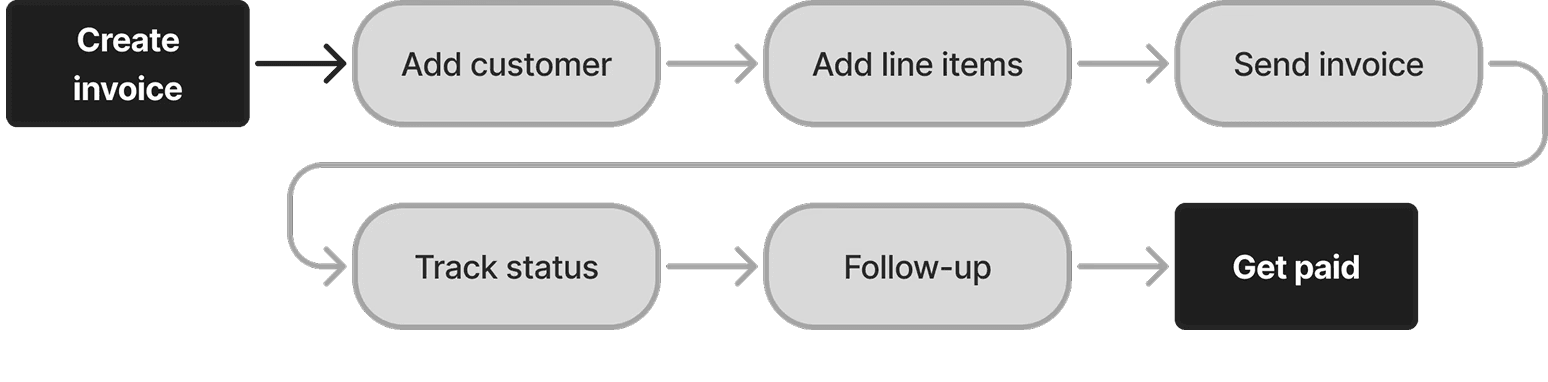

Separating the flows by their level of detail—from browsing and creation to the final viewing experience—helped clarify when each tool should be used.
Smart defaults: Reducing manual entry and setup to simplify task completion
Furthermore, user research showed that users frequently bill the same clients. I explored pre-populating saved client information to cut down on repetitive manual entry, and reducing setup time without removing control.
However, this added engineering complexity beyond the current timeline, so it's scoped as an intended future-state feature.

THE SOLUTION
Payment Links
Payment links are designed for fast and lightweight requests where users need to collect money without building a full invoice.
Track status at a glance with automated tables, including the link status and activity
Create one-time or reusables link for flexible products or services
Open a slide-out menu or drawer view to review link details and take quick actions in context
Edit, deactivate, or delete links without leaving the main page
Toggle to see transaction history for detailed records
Invoices
Invoices are designed for structured billing requests where users need additional detail, review, and follow-up.
Browse real-time payment and invoice status tracking
Create invoices with client details, line items, due dates, and payment terms
Review invoice information in a dedicated, full-page view for full context
Receive automated reminders and overdue payment notifications
Outcome
This project resulted in a 98% task completion rate with 13 tested and a 92% user satisfaction rating utilizing NPS with 26 participants . This supports end-to-end flows for creating, tracking, and managing payment requests.
We are excited to continue testing and validating the design direction, while seeing the results of this work enable and encourage new roadmap projects.
Learnings
Scope as a design tool that shapes the product
I initially approached the problem as a broad payments platform, but learned that reducing scope was just as important as designing new capabilities. This way, I could focus on the highest-value flows before investing in a larger blue-sky ecosystem.
Systems matter earlier than expected
Even with a limited initial release, establishing shared patterns and reusable components made it easier to maintain consistency across workflows and create a foundation for future user flows.